Asked how these skills should be measured, People’s Forum participants recognized that students needed multiple ways to show what they have learned and multiple pathways to graduation. They mentioned portfolios, capstone projects, community projects and self-reflection and self-assessment of their learning as options that should be available.
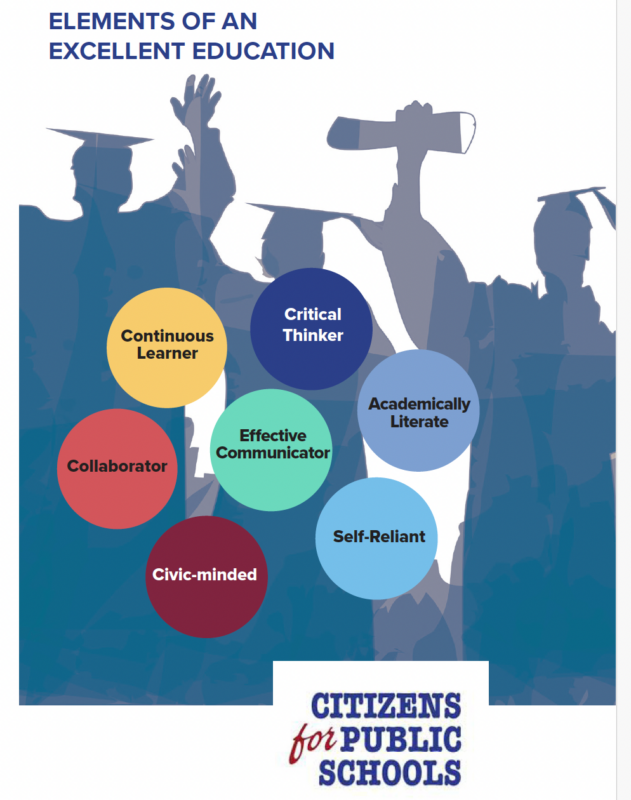
In the wake of Question 2 results, the CPS’s People’s Forums and the State Graduation Council’s findings, state leaders have a rare opportunity to respond with proposals that will support the kind of educational experiences people across the CommonWealth said they value. Will they pass this test by demonstrating visionary leadership, or fall back on tried and failed models of assessment? It is troubling that Governor Healey’s proposed graduation framework does not reflect the priorities expressed by Massachusetts voters or those who participated in the People’s Forums and the Governor’s Council’s listening sessions.
CPS compiled and analyzed all of the responses of participants in nine People’s Forums held in Cambridge, New Bedford, Worcester, E. Boston, Dorchester, the South End of Boston, Lowell, Salisbury and by Zoom (aimed at Western Massachusetts and rural participants). Here is a summary of our findings from all of the People’s Forums. (If you want to see the responses from each People’s Forum, click on the name of the location to see a spreadsheet with participants’ responses from that forum: Cambridge, New Bedford, Worcester, E. Boston, Dorchester, the South End of Boston, Lowell, Salisbury and by Zoom.)
Governor’s High School Graduation Framework Falls Short
Despite voters’ clear rejection of the MCAS graduation requirement and many calls for alternative pathways to graduation, the governor’s framework lays out a complex set of graduation requirements, with the emphasis on standardized end-of-course assessments to be designed, administered and scored by the state. On top of these will be a state-defined capstone or portfolio requirement and requirements for students to complete a rigorous course of study that aligns with higher education admissions requirements. The state is piling on more graduation requirements than we have had in the past. And while capstone performance assessments and portfolios are laudable ideas, they will be difficult to attain and pushed to the side if state-required end-of-course standardized tests, that count toward students’ grades, are implemented.
Piling multiple layers of new requirements on our students will create new obstacles rather than providing opportunities for them to increase their life skills and pursue their individual goals. Districts should be able to provide a range of alternative pathways for their students, not require them to check every box. Much like the MCAS graduation requirement, state-created and scored end-of-course tests will likely result in narrowing of the curriculum, teaching to the test, and taking the joy out of learning, without providing meaningful information on what many of our diverse students know and are able to do.
The appendix to the State’s recommendations lists 20 responses to the question “What should students know and be able to do?” Fifteen — including the top four — are not measured on standardized tests. Those four, in order, are:
• Communicate effectively verbally
• Exhibit critical thinking
• Interact respectfully with people from diverse backgrounds
• Identify credible sources of information.
The responses were similar among parents, educators, students, and employers; across races and ethnic groups; and for students with disabilities or students whose first language was not English.
Out of six ways students should demonstrate their competence, portfolios were the clear favorite. “Assessment or test” was the least favored. That was especially true of students with disabilities and their parents, and for those whose home language was not English. We suspect that if the category had specified “state-administered standardized test,” it would have been even more unpopular.
Based on the will of voters as expressed in the victory of Question 2 and the input from participants in our People’s Forums, we propose the following course of action to assess graduation readiness:
- Districts should adopt multiple ways for students to demonstrate graduation readiness, including capstones, portfolios, and other ways to assess both skills and content knowledge.
- New statewide course requirements can be considered but must be flexible enough to allow exemplary and interdisciplinary ways to teach content, including with career technical education, International Baccalaureate schools, and other innovative programs.
- The state’s role should be to support local efforts through professional development funds and sharing information, not to issue top-down edicts.
- Any new requirements must allow enough time for educators and their students to make the changes, with adequate funding for professional development and experimental programs.
The state must not repeat the mistake of the high-stakes MCAS, which, over 20-plus years, failed to improve education quality or close gaps in opportunity and was overwhelmingly rejected by voters.
As the decades-long record for the MCAS graduation requirement demonstrated, a high-stakes standardized instrument does not promote or measure the range of what stakeholders want students to know and be able to do. Did the state really hear those who spoke at its listening sessions, or were those sessions an exercise in selective listening to reaffirm a desire to impose a reboot of its failed model?
It’s time for a new blueprint for the future of our students.
People’s Forum endorsers included: Citizens for Public Schools, Educational Association of Worcester, Worcester Education Justice Alliance, Massachusetts Education Justice Alliance, Free Worcester Coalition, Worcester Education Collaborative, Senator Robyn Kennedy, the Massachusetts Teachers Association (MTA), AFT Massachusetts, New Bedford Coalition to Save Our Schools, Fall River Educators Association, New Bedford Educators Association, Greater New Bedford Educators Union, New Bedford Support Specialists Union, New Bedford Federation of Paraprofessionals Local 2378, Cambridge Education Association, Somerville Educators Union, Cambridge Retired Educators United, NAACP Cambridge Branch, Cambridge Families of Color Coalition, Educators of Color Coalition, Cambridge Families of Asian Descent, Our Revolution Cambridge, Cambridge Residents Alliance, The Black Response, UAW Region 9A, Senator Pat Jehlen, Rep. Christine Barber, Rep. Mike Connolly, Rep. Marjorie Decker, Rep. Steven Owens, Rep. Erika Uyterhoeven, Boston Debate League, Maverick Landing Community Services, Boston Student Advisory Council, Boston Teachers Union, St. Stephens Youth Programs, Quality Education for Every Student , United Teachers of Lowell, Lowell Education Justice Alliance, MA Education Justice Alliance, Merrimack Valley Central Labor Council, Rep. Rodney Elliott, Rep. Vanna Howard, Lowell School Committee members Dave Conway, Connie Martin & Dominic Lay, Lynn Councillor at Large Brian LaPierre.
Citizens for Public Schools is a 43-year-old statewide public education advocacy organization.
Pages: 1 2