People’s Forums Revealed Expansive Vision of What High School Grads Should Know. State Leaders Must Listen and Respond.

[Haga clic aquí para ver la versión en español.]

If Governor Healey’s Statewide High School Graduation Framework, released on December 1, is a first draft, it needs serious revisions for the final version to meet the needs of our students and schools. The framework includes state-created and scored end-of-course tests, or standardized tests in new clothing. This recommendation ignores the will of the voters who in November 2024 decided overwhelmingly to eliminate MCAS and any other standardized test as graduation requirements. Changes must be made for the state to do more than pay lip service to demands for a whole child, 21st century education, as well as flexibility, educator autonomy and student agency. 

Citizens for Public Schools, in cooperation with other education organizations, organized a series of public forums across the state to find out what parents, teachers, students, and other people concerned with our public schools really want for graduation readiness requirements.   → Read More

Pages: 1 2

CPS Statement in Response to Governor’s Council Graduation Requirements: “Voters said no to one-size-fits-all tests, but Governor’s graduation framework can’t let them go”

If the State Graduation Council’s Interim Report is a first draft, it needs serious revisions for the final version to meet the needs of our students and schools. The report comes after voters resoundingly rejected a state-imposed standardized exam and after extensive input about what stakeholders want students to know and be able to do. Changes must be made for the state to do more than pay lip service to demands for a whole child, 21st century education, as well as flexibility, educator autonomy and student agency.

Despite many calls for multiple pathways to graduation, the interim report lays out a multilayered set of graduation requirements, with the emphasis on standardized end-of-course assessments to be designed, administered and scored by the state. On top of these will be a state-defined capstone or portfolio requirement and requirements for students to complete a rigorous course of study that aligns with higher education admissions requirements.   → Read More

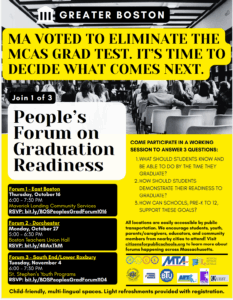
MA voted to eliminate the MCAS grad test. It’s time to attend a CPS People’s Forum to help decide what comes next.

Citizens for Public Schools, in cooperation with other education organizations, is organizing a series of six  public forums across the state where parents, teachers, students, and other people concerned with our public schools can come together to discuss three fundamental questions:

1. What should students know and be able to do by the time they graduate from high school?
2. How should students demonstrate their readiness to graduate?
3. What should high school look like to prepare students for your recommended graduation requirements?

The first forum was on Wednesday, April 30 at Cambridge Rindge and Latin School. Read about it here. The next forum was in New Bedford on Saturday, May 24. Read about it here. Our third forum was in Worcester at the YWCA at on Monday, September 29. Read about it here.

The meetings follow on the approval of Question 2 last November when Massachusetts voters decisively rejected the one-size-fits-all MCAS graduation requirement, 59 to 41 percent.   → Read More

Check out CPS’s updated fact sheet on opting out of MCAS

In the wake of the state’s overwhelming vote to pass Question 2 in November 2024, which eliminated the MCAS high school graduation requirement, CPS has updated its fact sheet on opting out. You can read the updated fact sheet here.

   → Read More

Vocational Education Justice Coalition Voices Deep Concerns with Proposed Admissions Regs

  • Department of Elementary & Secondary Education proposes to require use of admissions lottery, but would allow schools to exclude as many as half of students from many cities based on attendance records
  • DESE’s New Proposed Vocational Admissions Policy ends three barriers that discriminated against students from protected classes (Grades, Guidance Counselor Recommendations, Interviews) and eliminates ranking of applicants
  • BUT It SIGNIFICANTLY RAISES THE BARRIER ATTENDANCE can play in disqualifying many students from admission
    • Statewide, over one-third of Latino, low-income, and English Learner students would be excluded from applying to vocational schools
    • In a sample of 10 Gateway Cities, 30-53% of students would be excluded from attending
  • It Further Clarifies the Discipline Offenses That Exclude Students From Applying, however the criteria are still overly broad
  • The Vocational Education Justice Coalition asks Governor Healey and the Board of Education to eliminate the proposed attendance criteria and more narrowly focus the discipline criteria

The Vocational Education Justice Coalition has deep concerns with the Commissioner of Education’s proposed revised regulations on vocational school admissions, to be presented to the Board of Elementary & Secondary Education (BESE) at its February 25, 2025 meeting.   → Read More